
When it comes to fine yarns, few names evoke quality, elegance and tradition as much as Lisle Cotton. Yet those who encounter this material for the first time are often surprised by an apparent paradox: Lisle Cotton does not originate in Scotland. Its history is in fact the story of the finest cotton in the world, an English chemical invention and Scottish industrial capability.
In this guide we trace the origins of long-staple cotton, the birth of mercerization and the role of the Paisley mills, through to modern Lisle Cotton socks. A story that Ciocca, an Italian hosiery manufacturer active since 1912, knows well: we have been working with genuine Lisle Cotton for over a century.

The origins: Egyptian cotton from the Nile Delta
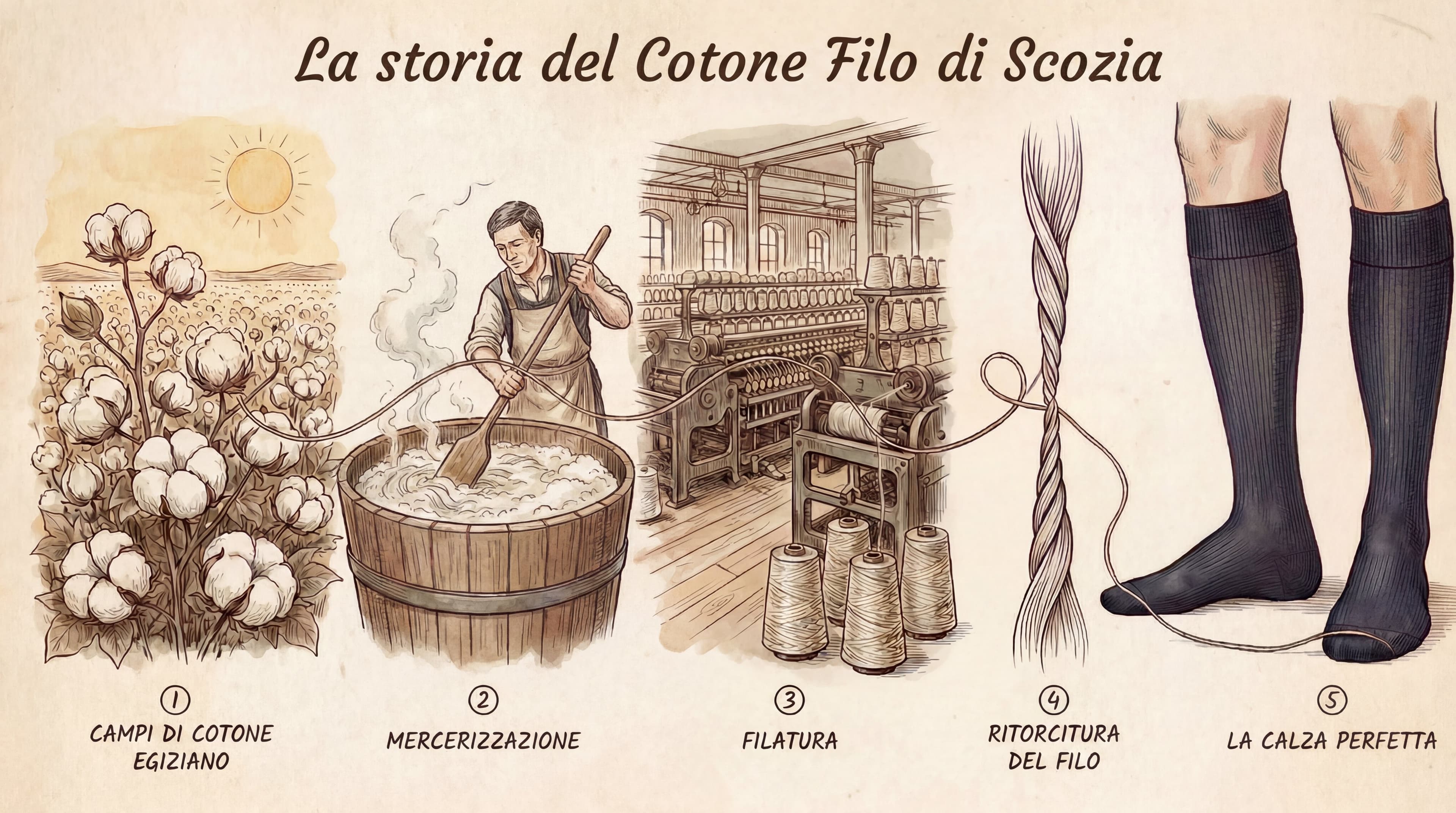
The history of Lisle Cotton begins far from Scotland, in the fertile lands of the Nile Delta, in Egypt. Here, for over a century, some of the most prized varieties of long and extra-long staple cotton have been cultivated. It is precisely these fibres, particularly fine, long and resistant, that make it possible to produce the finest yarns, soft to the touch and at the same time extraordinarily durable.
During the 19th century the European textile industry was in constant search of ever finer fibres. Egyptian cotton quickly established itself as a prime raw material thanks to its length and uniformity: characteristics that still today distinguish genuine Lisle Cotton from ordinary cotton.
From Egypt to England: John Mercer and mercerization
The real turning point came thanks to the work of English chemist John Mercer (1791–1866), considered one of the fathers of modern textile chemistry. In 1851 Mercer patented an innovative treatment of cellulose using caustic soda, destined to revolutionize the industry.
The process, which subsequently took the name of mercerization, allowed fibres to acquire greater strength, improved ability to absorb dyes and a characteristic surface brilliance. The technique was later refined by applying tension to the yarn during treatment.
To this day, mercerization remains one of the fundamental steps in the production of the finest cotton yarns, and is one of the hallmarks that make a Lisle Cotton sock unmistakable.
Scotland enters the story: Paisley and J. & P. Coats
While the invention was born in England, it was Scotland that transformed it into an industrial success. In the second half of the nineteenth century, the city of Paisley, in the Scottish Lowlands, was one of the most important textile centres in the world. Here operated J. & P. Coats, a company destined to become one of the largest international yarn producers.
Thanks to the combination of fine Egyptian cotton and the most advanced processing techniques of the era, yarns produced in Paisley acquired an extraordinary reputation on international markets. It was precisely this association between superior quality and Scottish production that gave rise to the name we still know today as Lisle Cotton.
In the industry there is also a captivating tradition according to which an Italian entrepreneur, during a trip to England in the nineteenth century, would have discovered the advantages of mercerized yarn and promoted its spread across Europe. Although frequently cited in popular literature, the episode is not documented with certainty and should be considered an industrial tradition rather than a historically verified fact.

Lisle Cotton, Lisle Cotton Yarn and Fil d'Écosse
A little-known aspect concerns the different names this yarn has taken in various countries. In the English-speaking world it is traditionally referred to as Lisle Cotton Yarn, in France it is known as Fil d'Écosse and in Spanish-speaking countries as Hilo de Escocia.
Despite the different names, the reference is always to the same concept: a very high quality cotton yarn, obtained from selected long fibres and subjected to advanced processing.
How genuine Lisle Cotton is made: from fibres to sock
Today the term Lisle Cotton does not simply identify a cotton coming from Egypt. To be considered as such, the yarn must go through a precise sequence of processes.
1. Cotton selection
The process starts with long or extra-long staple cottons, the raw materials capable of guaranteeing regularity and fineness in the yarn.
2. Spinning
The fibres are transformed into yarn, eliminating short fibres and impurities to obtain a uniform thread.
3. Twisting
Two or more threads are twisted together to increase regularity and strength: this is the basis of long-lasting durability.
4. Gassing
Surface fibres are removed by passing the yarn through a controlled flame. The result is a smoother surface, with less pilling and greater brilliance.
5. Mercerization
The yarn is treated with caustic soda under tension: lustre, colour brilliance, mechanical strength and dimensional stability all increase. The final result is an extremely smooth, bright, strong and pleasant-feeling yarn on the skin.
What makes genuine Lisle Cotton special
More than one hundred and fifty years of history have defined the characteristics a yarn must possess to be considered genuine Lisle Cotton:
Long staple fibre: greater yarn regularity.
Mercerization: silky lustre and brilliant colours.
Gassing: smooth surface, almost silky to the touch.
Twisting: greater durability and wash resistance.
Selected cotton: high comfort and freshness, ideal even in summer.

Essential timeline of Lisle Cotton
1791 – Birth of English chemist John Mercer.
1851 – Patent of mercerization.
Second half of the 19th century – Industrial spread of mercerized yarns.
Late 19th century – Paisley becomes one of the world's leading centres for quality yarn production.
1912 – Ciocca is founded, bringing the Lisle Cotton tradition to Italian hosiery manufacturing.
20th–21st century – Lisle Cotton remains synonymous with elegance, comfort and lasting durability.
How to choose a Lisle Cotton sock today
Knowing the history of the yarn also helps to recognise its quality at the time of purchase. Here is a practical checklist:
100% cotton composition on the label: a significant presence of polyester indicates an economy blend, not genuine Lisle Cotton.
Terms such as "Egyptian cotton", "mercerized" or "double twisted" in the product specifications.
Slightly lustrous appearance, almost silky, even in dark shades.
Cool and smooth feel: the sock glides between the fingers and leaves no fluff.
Reinforced toe and heel, a sign of careful craftsmanship.
Recommended Ciocca Lisle Cotton products
Ciocca has been working with genuine Lisle Cotton since 1912, using long-staple Egyptian cotton yarns. Below are some lines to start with:
Men's Long Socks in Lisle Cotton – The classic choice for the office, formal occasions and suits.
→ Discover men's Lisle Cotton socks
Men's Short Socks in Lisle Cotton – Ideal with loafers, extremely fresh in spring/summer.
→ See short Lisle Cotton socks
Want to learn more about how to distinguish quality? Also read our guide "Lisle Cotton: what it really is and how to recognise a quality sock".
Frequently Asked Questions (FAQ)
The name does not derive from the origin of the cotton, but from Scotland, where in the second half of the 19th century – especially in the city of Paisley – some of the most celebrated mercerized yarns were produced and sold. The base cotton is long-staple, historically Egyptian.
Mercerization was developed by English chemist John Mercer (1791–1866), who in 1851 patented a treatment of cellulosic fibres using caustic soda. The process increases strength, brilliance, dye absorption and yarn stability.
From the cultivation of long and extra-long staple cotton. The most prized varieties have historically come from Egypt, particularly from the agricultural areas of the Nile Delta. Long fibres allow for finer, more regular, stronger and softer yarns.
Yes, they are names for the same yarn in different languages. In Italy it is called Filo di Scozia, in the English-speaking world Lisle Cotton, in France Fil d'Écosse and in Spain Hilo de Escocia. The name changes, not the concept: high quality cotton from long fibres, processed using advanced techniques.
It is not enough for the cotton to come from Egypt: it must be long or extra-long staple, carefully spun, gassed, twisted and mercerized. Only this sequence of processes produces the smooth, bright, strong and pleasant-feeling yarn we call Lisle Cotton.
An excellence that spans the centuries
More than one hundred and fifty years after its establishment on international markets, Lisle Cotton continues to represent a benchmark in quality textile manufacturing. Born from the meeting of the finest Egyptian cotton, English scientific innovation and Scottish productive capability, this yarn remains synonymous with elegance, comfort and lasting durability.
It is therefore not merely a material, but one of the most fascinating stories in European textile tradition – a story that Ciocca has carried forward since 1912 in every pair of Lisle Cotton socks.
Discover the men's Lisle Cotton sock collection at ciocca.it →